
Montgomery Township Previous Residents Sources
A backward address trail has several time layers. Recorded land documents establish a title sequence. Historical directories and census schedules can add period household context. Probate, marriage, birth, death, newspaper, and cemetery routes may help explain a transition. None of these sources, alone, proves every person who lived in a home. The strongest result keeps the document date, the legal or parcel clue, and the exact relationship shown by each source.
| Source | Years It Covers | Where Held | What It Shows |
|---|---|---|---|
| Recorder of Deeds land records | From September 10, 1784 | Montgomery County Recorder Public Access System, counter, or mail | Recorded title sequence, mortgages, plans, and legal-description clues |
| Register of Wills probate dockets | 1784 to 1987 docket books; computer records from 1988 | Montgomery County Register of Wills | Estate and administration transitions, executors, and probate context |
| Eastern Montgomery County telephone directories | October 1944 to April 1955 | Library of Congress | Regional telephone and address listings as printed in each edition |
| Township Historical Society collection | 1943 to 2012 inclusive; bulk 1988 to 2012 | Montgomery Township Historical Society | Property files, owner genealogies, maps, photographs, clippings, and people files |
| Federal census | Public schedules through 1950 | National Archives and authorized access routes | A dated household snapshot where the schedule identifies the place |
Begin with the record closest to the date in question. A recent deed may offer the first party and legal-description clue. For a mid-century household question, a dated telephone directory, census source, and property file may be more useful. The Township’s permit process can supply a construction or alteration chronology where records were retained, but no public historical permit-search database was verified.
Montgomery Township Past Residents Start by Address
Use Montgomery County Property Records with the street address or parcel ID to establish the parcel context. The public system offers address, parcel, advanced, map, and sales routes. It does not offer an owner-name search, which was discontinued on June 17, 2022. That is a deliberate local privacy limit. A surname guess should not replace an address-to-parcel search.
Keep the address as entered, the stated municipality, the postal label, the returned parcel identifier, and any verified book, page, or document clue. The Board of Assessment Appeals maintains assessment rolls, tax maps, and the ownership registry, but its map is not a title examination or boundary survey. The parcel becomes the bridge to a recorded document. A recorded party, a mailing addressee, an owner, and an occupant can be different people.
Tracing Montgomery Township Previous Residents Deeds
The Recorder’s historical-research resources explain the property-history route. The Recorder of Deeds was created in 1784, and its public record series begins September 10, 1784. Its Public Access System requires an account. In the Real Property department, the Search Term accepts a party, subdivision, document type, or document number. Recorded-date controls narrow the search. The index is by name and document clues, not by property location.
The Recorder’s property-history guidance is the source for the recorded-document route and its archival referrals.
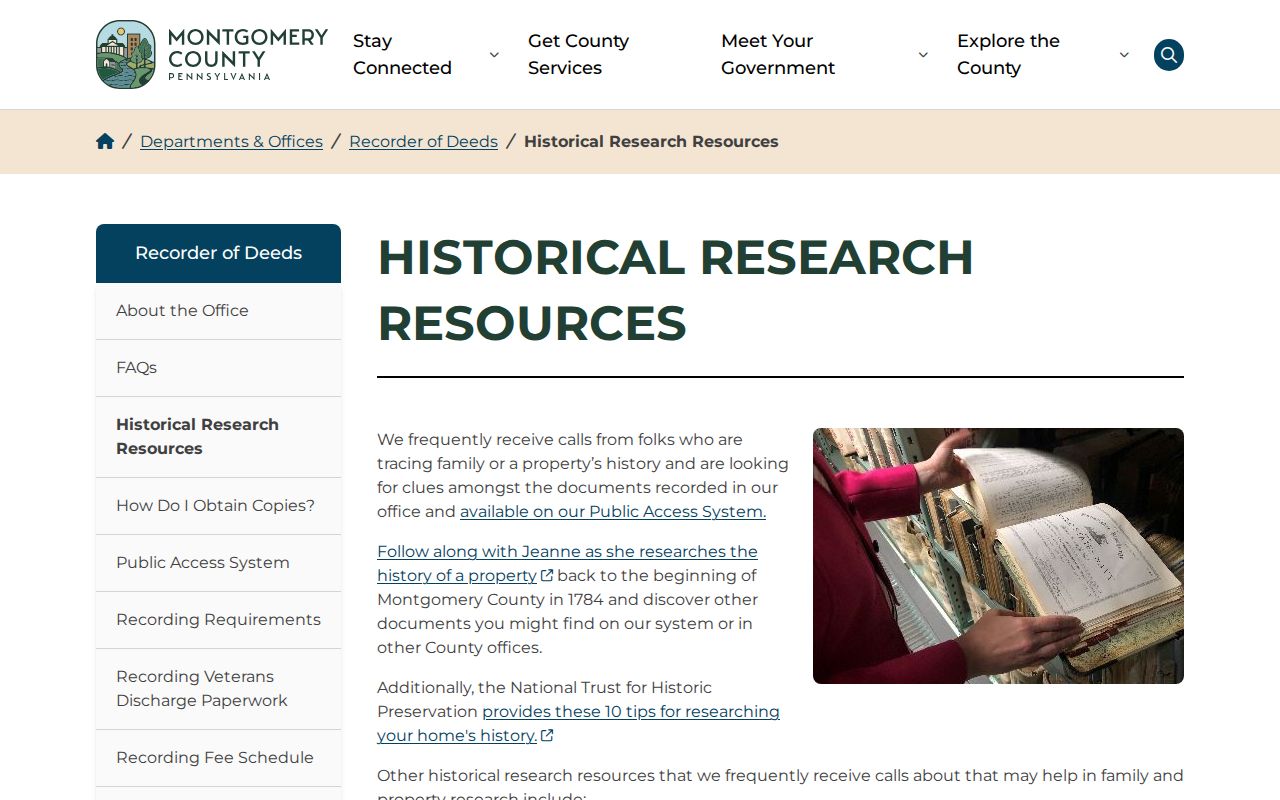
Remote image access is separate from an index search: the stated price is $25 for a calendar day ending at midnight or $300 for a month, with plain copies at $0.50 per page and certified copies at $10.50. Counter and mail requests remain available. Use the legal description on the actual document to confirm the parcel before accepting it as part of the same chain.
- Search the current street address or parcel in Property Records and retain the parcel and any transaction clue.
- Use a valid party, document number, document type, or subdivision clue in the Recorder’s Real Property search.
- Open or request the current acquisition document through the applicable image, counter, or mail route.
- Read the grantor, grantee, recording date, and legal description. The seller on one acquisition can supply the predecessor name for the next search.
- Repeat by document date, resolving subdivision or lot changes with plan records, tax maps, or original documents rather than a modern street label alone.
- Grantor
- The party conveying an interest in a recorded document.
- Grantee
- The party receiving that recorded interest. In a backward search, a prior owner is often found as grantee on an earlier acquisition.
- Chain of title
- The sequence of recorded transfers used to trace legal ownership, not a list of every household.
- Legal description
- The land-description language in a recorded instrument. It can bridge an older address form that no longer matches the modern street address.
Montgomery Township Previous Residents Book Gaps
The Recorder gives a local warning that prevents a false break in a deed trail. Some book numbers were never created. The listed deed gaps are 1325, 1326, 1377 through 1381, and 1540 through 1544. The listed mortgage gaps are 1572 through 1580, 3340, and 3454. Plans 16 through 21 were also never created. A missing number on a sequence is not proof that a transaction disappeared or that the property history ended.
Check the apparent gap with the Recorder before drawing a conclusion. Search the parties, date, document type, and legal description around the gap. If remote access does not resolve the question, use the public computers at the Recorder counter or request a defined copy by mail. This is an archival limitation, not a reason to fill the chain with an assumed transfer.
Montgomery Township Past Residents Postal Labels
Historic address research must allow for five postal labels: Lansdale 19446, North Wales 19454, Montgomeryville 18936, Colmar 18915, and Chalfont 18914. An older directory or file can use one of these place names even when the property lies in Montgomery Township. A postal city is a mailing convention, not a municipal determination. Search the Township name and the original label, then retain both in the research notes.
Do not assume a street number existed unchanged in the eighteenth or nineteenth century. Parcel history and the legal description often carry the connection when a street form, road name, subdivision, or postal place changed. No official Township-wide street-renumbering date was found in the research. The accurate approach is to preserve the historical form and verify it against land records, tax maps, or the original document.
Montgomery Township Previous Residents in Phone Books
The Library of Congress Eastern Montgomery County telephone-directory collection offers a bounded household clue for October 1944 through April 1955. The 868 images are regional and may not include every Township household. Search the dated reel for the name and postal place, then record the printed spelling, telephone, address form, and edition date. A directory listing is a period connection, not proof of ownership or a current presence.
The Township historical collection can add maps, deed copies, photographs, owner genealogies, and local notes for a property or person. The historical volumes themselves are organized in more detail on the Montgomery Township city directories page, which also explains the limits of the regional shelf.
Montgomery Township Historical Property Files
The Montgomery Township Historical Society collection finding aid describes about 20 linear feet of community material. Property files can hold notes, deed copies, maps, photographs, and owner genealogy. People files can contain notes, family genealogy, document copies, and material about a named person’s home. The collection’s inclusive dates are 1943 to 2012, with bulk records from 1988 to 2012, and it is primarily a physical reading-room collection.
Ask for a defined property or person file using the exact address, postal label, approximate period, and any known name spelling. Keep a file’s notes distinct from a recorded instrument. A map may locate a property and a photograph may date a feature, but neither changes the legal-description verification required for a deed-chain conclusion.
Montgomery Township Probate and Vital Clues
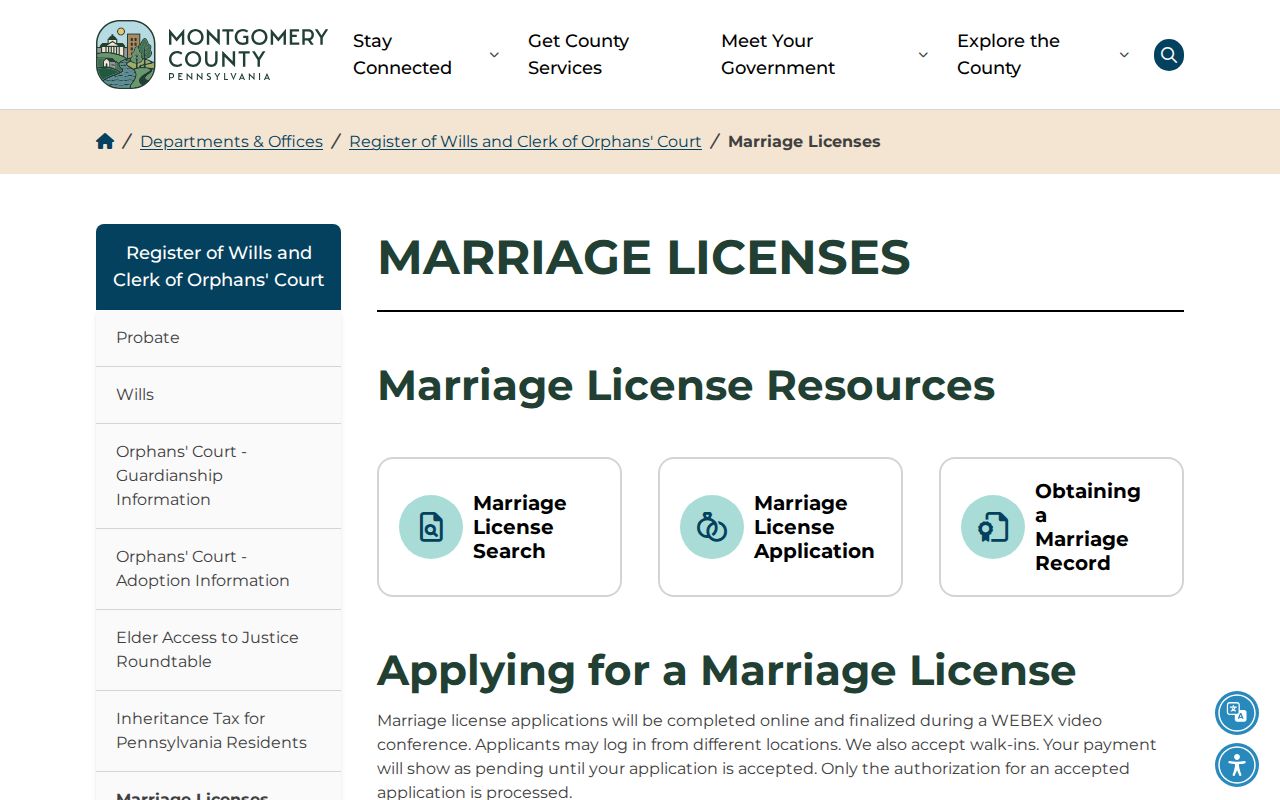
Estate and vital records can help close a transition after the property trail is documented. Montgomery County Register of Wills probate docket books cover 1784 through 1987, with computer records from 1988 forward. County marriage licenses issued from 1885 to the present are open for viewing. County birth and death records cover 1893 to 1915, while Pennsylvania statewide vital records begin in 1906. These records provide event or estate context and should not be treated as automatic residence proof.
The Montgomery County marriage-records route identifies the Register’s marriage access path.
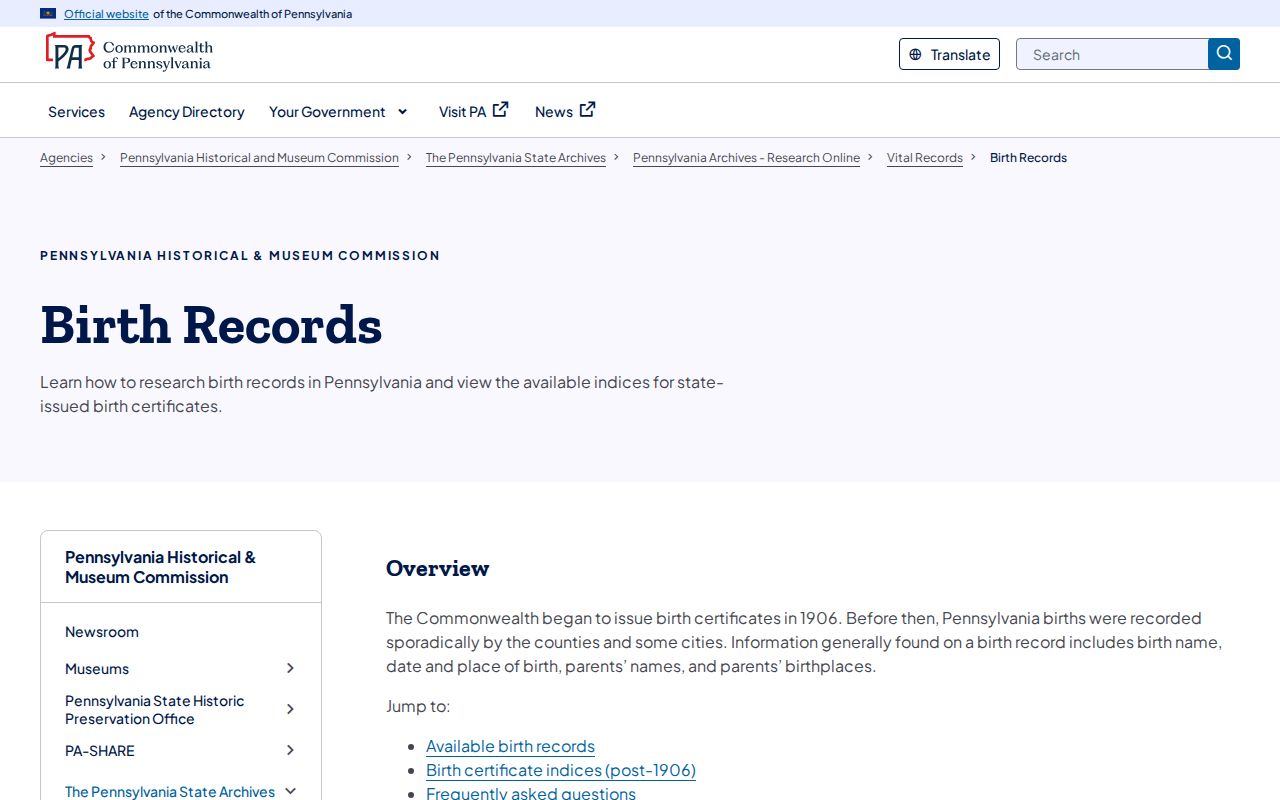
For mature state archival records, births become public at 105 years and deaths at 50 years through PHMC. The State Archives has image routes for births from 1906 to 1917 and deaths from 1906 to 1972. Retain the record’s date, certificate reference, and custodian when comparing it with a deed or directory item.
The PHMC birth-records resource shows the state archival route for eligible historical birth records.
Vital evidence can identify a date or family connection that deserves further research. It does not replace the parcel and legal-description check that ties a document to an address.
Montgomery Township Archive and Court Routes
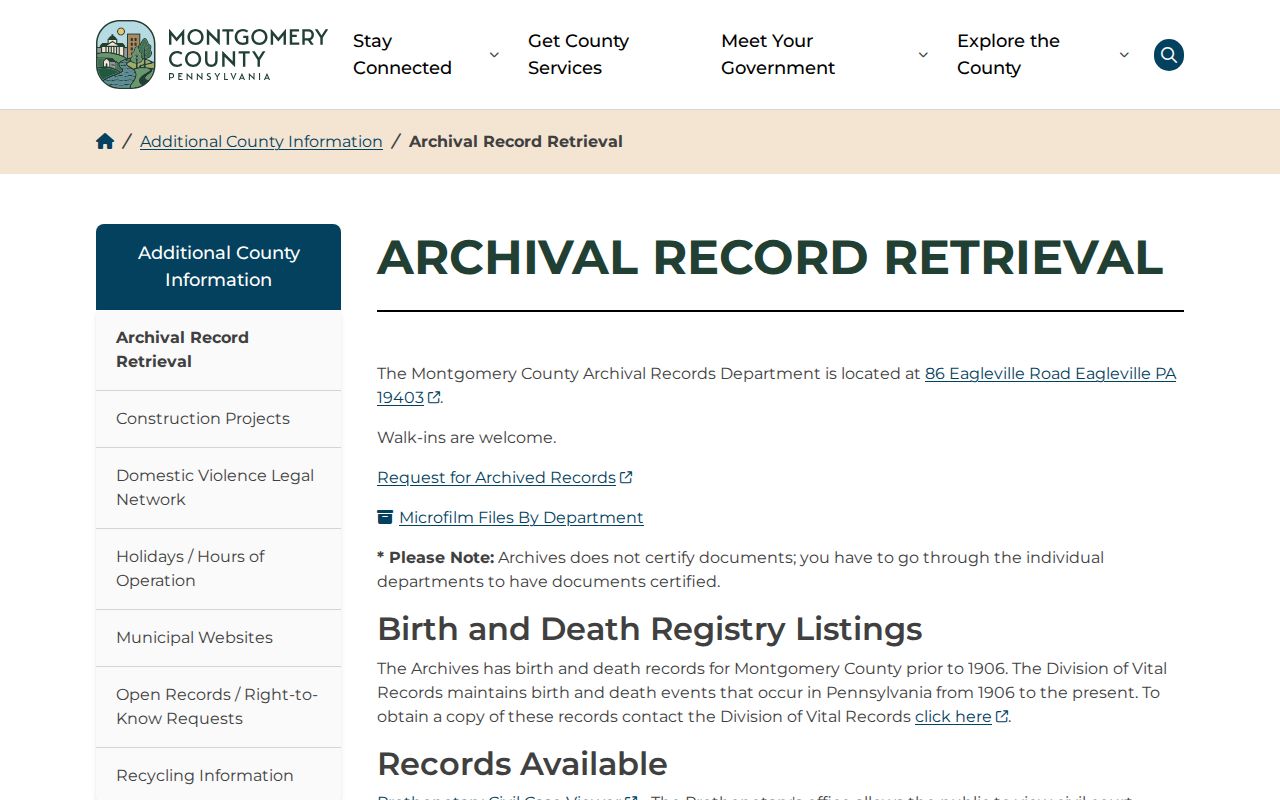
When the online index or a local file stops, use the documented custodians instead of guessing. Montgomery County Archives is at 86 Eagleville Road and can be reached at 610-278-3441 for historic county-record questions. The Recorder’s history resources also direct researchers to county, state, and national archives, historical societies, marriage records, and cemetery mapping. The correct office depends on whether the unanswered question is a land transfer, estate, vital event, newspaper mention, or local collection item.
The Montgomery County Archives retrieval page is the county archival contact route for older records.
A civil case can be another dated document source when it actually names a party or parcel. The Prothonotary Civil Viewer is a county civil-search route, and its images are paid access. Do not turn a court search result into a home-history conclusion without a shared document clue and date.
The Montgomery County Prothonotary Civil Viewer is the official entry point for its civil case-search system.
Use a civil filing as one source in a dated chain, keeping its case number and the court’s own access limits with the result.
Montgomery Township Address Evidence Limits
Address-history research works best when it distinguishes a recorded party, legal owner, telephone-directory listing, census household, and historical-file subject. A later owner is not automatically a prior occupant. A directory listing may be incomplete. An estate file may identify an executor without showing where that person lived. These categories often fit together, but only after the address, date, and source language support the connection.
Preserve the original source and report a suspected indexing, assessment, court, or vital-record error to its custodian. An address history should document what each record says, not make a present-day claim about a home or person.